Indian olive pickle is made from jolphai (also spelt zolphai or jalpai), a sour green fruit of the Elaeocarpus tree that grows across Assam and the rest of the Northeast. Despite the English name, it is not related to the Mediterranean olive. In Assam it is eaten with salt and chilli, cooked into chutney and, most of all, turned into pickle.
Say “olive” to most people in India and they picture pizza toppings or a bottle of oil. Say “jolphai” to someone from Assam and they picture a winter afternoon, a paper cone of salted fruit and puckered faces. This guide explains what the fruit really is, when it is in season and how Northeast homes eat it.
Quick facts: jolphai (Indian olive)
- Local names: zolphai or jolphai (Assamese, জলফাই), jalpai (Bengali), chorphon (Manipuri), zawlphai (Mizo) [2][5][6].
- Scientific name: Elaeocarpus floribundus in most Indian botanical sources; some sources use Elaeocarpus serratus [1][2][5].
- Family: Elaeocarpaceae, a genus of about 350 species [1]. The true olive, Olea europaea, is a different plant [3].
- Season: flowers in April–May; fruit is picked roughly from August to November [1][2][7].
- Fruit size: about 4–4.5 cm long and 16–22 g in a North Bengal study [1].
- Grown: mostly in home gardens and wild trees, with no commercial orchards reported [2].
Is Indian olive the same as olive?
No. Jolphai and the Mediterranean olive only share a look and a name. The Bangladesh national encyclopaedia, Banglapedia, notes that jalpai is Elaeocarpus floribundus, while the true olive is Olea europaea, grown mainly for its oil [3].
Jolphai yields no oil [3]. It is a green, one-seeded fruit, and the part you eat is the firm flesh around a hard stone [1]. Raw, it is sour and astringent, and it can leave a tingling feeling on the lips [2][7].
So when someone from outside the Northeast says “But olives don’t grow in India!”, the answer is simple: this is a different fruit that happens to share a nickname.
What is jolphai called in English, and what is its scientific name?
In English, jolphai is called Indian olive, Ceylon olive or wild olive [2]. Its scientific name depends on which source you read, and this is one place where the experts disagree.
- A 2017 study of the fruit in North Bengal, and Banglapedia, call it Elaeocarpus floribundus [1][3].
- Down To Earth (2019) and Wikipedia use Elaeocarpus serratus, the Ceylon olive of Sri Lanka and South India [2][6].
- The India-focused plant database eFlora of India lists one older name, Elaeocarpus serratus Roxb. ex Wall., as a synonym of E. floribundus, which may explain part of the mix-up [5].
Kew’s Plants of the World Online lists Assam within the native range of E. floribundus [4]. For an Assamese kitchen, the label matters less than the fruit: the sour green jolphai sold in winter markets.
When is jolphai season in Assam?
Jolphai is a late-monsoon to early-winter fruit. Most sources place the harvest between August and November, although the exact months shift by place and source.
- The North Bengal study recorded flowering in April–May and harvest from August to October [1].
- Down To Earth gives flowering in April–May and mature fruit in October–November [2].
- Wikipedia, citing work on the Karbi people of Assam, says they collect ripe and unripe fruit from August to October [6].
- Banglapedia gives December for Bangladesh [3], and a produce guide notes that some regions keep harvesting until January [7].
In short, look for fresh jolphai in Northeast markets between August and November. For the rest of the year, the pickle jar keeps it on the table.
How do people in the Northeast eat Indian olive?
Raw with salt and chilli, boiled into chutney, or pickled in mustard oil. Each state has its own favourite.
Raw, with salt and chilli
In many Assamese homes, the first jolphai of the season is simply washed, lightly crushed and tossed with salt and green or dry chilli. Children eat it outside the school gate; grown-ups eat it after lunch. In Manipur, Down To Earth reports, chorphon is eaten raw with chillies, salt and sugar [2]. In Arunachal Pradesh it is eaten raw and also pickled [2].
Boiled, as chutney or a souring agent
Boiled or steamed, the fruit softens and stays sour; Down To Earth describes the smell as close to raw mango [2]. That is why it works as a souring agent in cooking. In Bengal, the boiled fruit is mashed into a sweet-and-sour chutney with panch phoron, red chilli, salt, raisins and sugar or jaggery [2]. Bengal also makes jalpai ambal and jalpai achar [6].
As pickle
Pickling is the most common way to keep jolphai. Among the Karbi of Assam, ripe fruit is made into a sour pickle [6]. In our own family kitchens in Assam, jolphai is cooked with mustard oil and whole spices and stored in jars, so a spoonful can sit beside rice and dal long after the season ends.
How do you eat Indian olive pickle?
Eat it the Assamese way: a small spoonful on the side of the plate, mixed into a few mouthfuls of hot rice at a time. It also pairs well with plain dal, khichdi, paratha and a simple aloo pitika (mashed potato with mustard oil).
Three easy ideas from our own kitchen:
- Dal-chawal lift: add half a spoon of pickle to a plate of rice and masoor dal.
- Paratha partner: serve it with a plain or aloo paratha in place of mango achar.
- Sandwich spread: chop a few pieces finely and mix with butter or hung curd.
Always use a clean, dry spoon and close the lid after use, and follow the storage note on the jar label.
Jolphai is only one of the sour, sweet and fiery jars on an Assamese table; our guide to Assamese pickles covers khorisa, bogori, ou tenga, kharoli and more.
Where does the name Jalpaiguri come from?
The North Bengal district of Jalpaiguri is linked to this fruit. Down To Earth explains that “jalpai” is the plant and “guri” means the place where it grows [2]. The Terai belt of West Bengal, including Jalpaiguri, Alipurduar and Cooch Behar, is one of the areas where the tree is common [2].
Down To Earth also reports that a single tree can give roughly 40–60 kg of fruit a season, and that it is grown mainly around homes rather than in orchards [2]. The 2017 North Bengal study calls jalpai a less exploited, under-utilised fruit of the region [1].
If you enjoy this kind of story, read our guide to khorisa, Assam’s bamboo shoot pickle, the other half of most Assamese pickle shelves.
Taste it
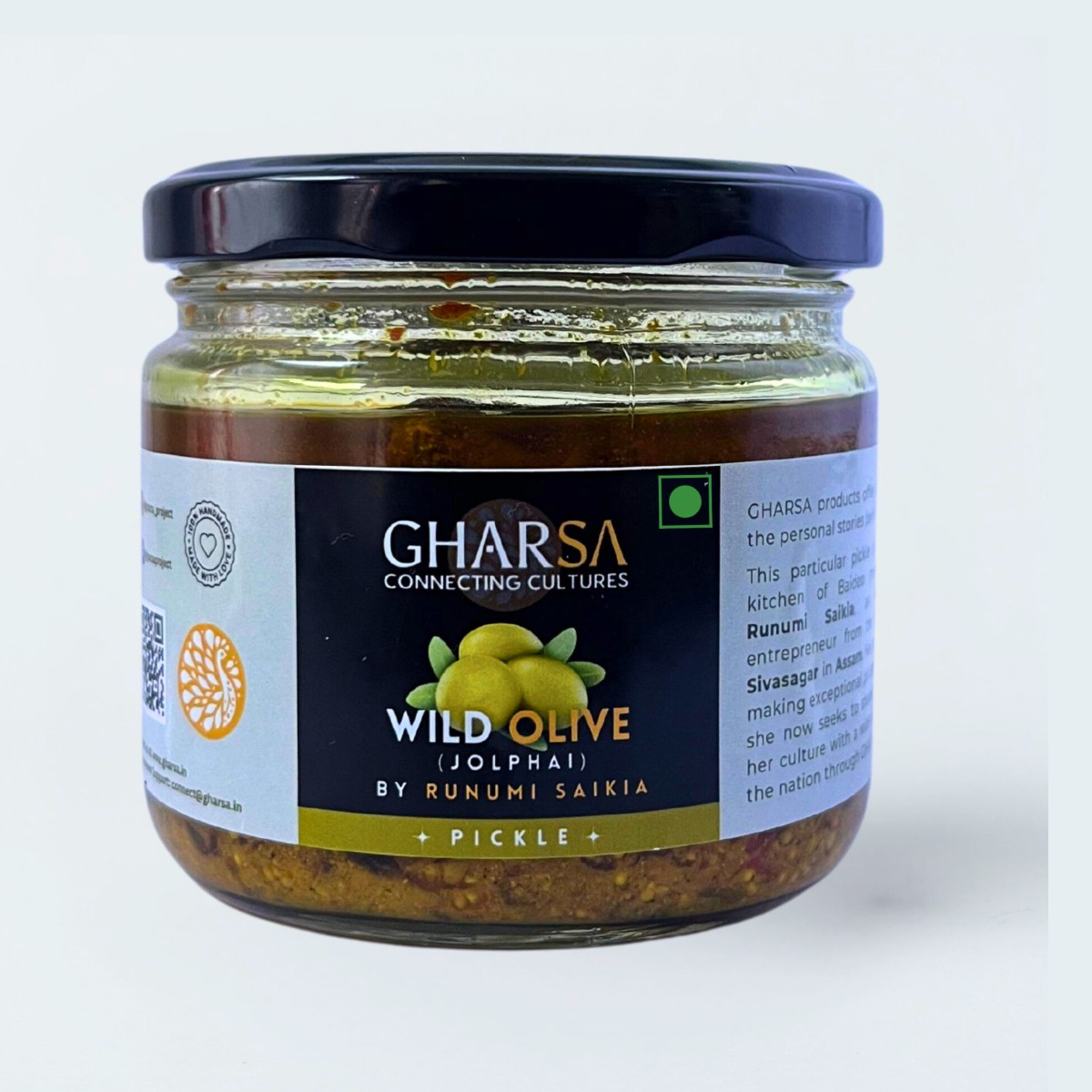
GHARSA’s Jolphai (Indian Olive) Pickle lists olive (jolphai), mustard oil, salt, cumin, coriander, yellow mustard and black mustard. It is also in the Taste of Assam box with Khorisa and Meetha Bogori, and in our pickle gift boxes.
Questions or bulk orders? Message us on WhatsApp.
Frequently asked questions
What is jolphai in English?
Jolphai is the Assamese name for the Indian olive, also called Ceylon olive or wild olive. It is the sour green fruit of an Elaeocarpus tree, usually named Elaeocarpus floribundus, though some sources say Elaeocarpus serratus. Bengalis call it jalpai and Manipuris call it chorphon. It is not related to the Mediterranean olive.
Is Indian olive the same as the olive used for olive oil?
No. The olive used for olive oil is Olea europaea, a Mediterranean tree. Indian olive belongs to the genus Elaeocarpus, in a different plant family, and gives no oil. The two fruits only look alike: both are oval and green. Indian olive is sour and astringent and is mostly eaten raw with salt, as chutney or as pickle.
When is jolphai season?
Jolphai trees flower in April and May, and the fruit is picked roughly from August to November. A North Bengal study recorded harvest from August to October, while Down To Earth gives October to November. In Assam, the fruit usually shows up in markets after the monsoon and into early winter, which is when families make pickle.
Can you eat Indian olive raw?
Yes. Ripe or unripe Indian olive is eaten raw across the Northeast, usually with salt and chilli, and in Manipur with sugar as well. It tastes sour and astringent and can make your lips tingle. Wash the fruit well and eat the firm flesh around the hard stone, a little at a time.
Image credits
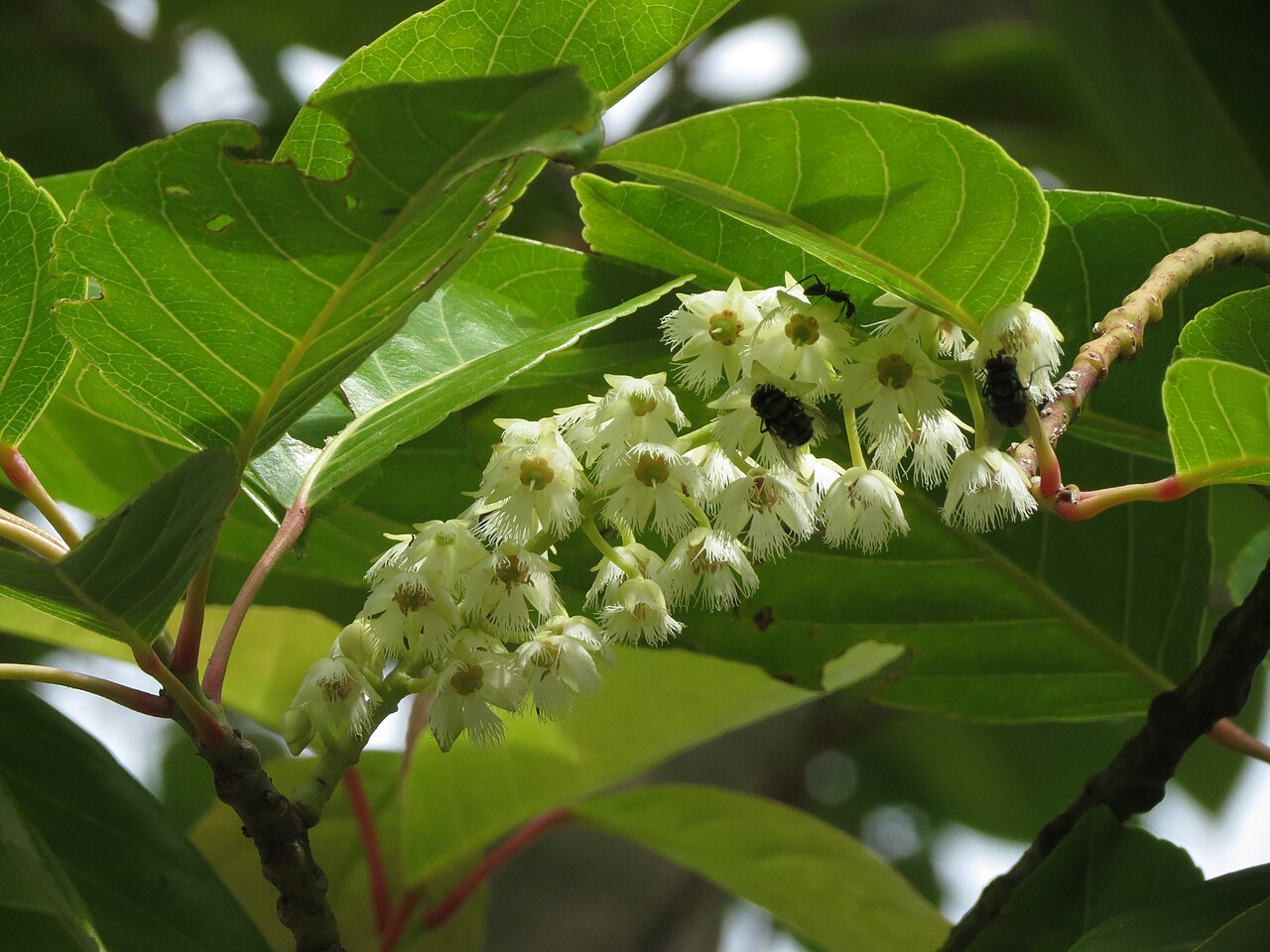
- Featured image, Indian olive flowers (Elaeocarpus floribundus): Forestowlet, CC0, Wikimedia Commons
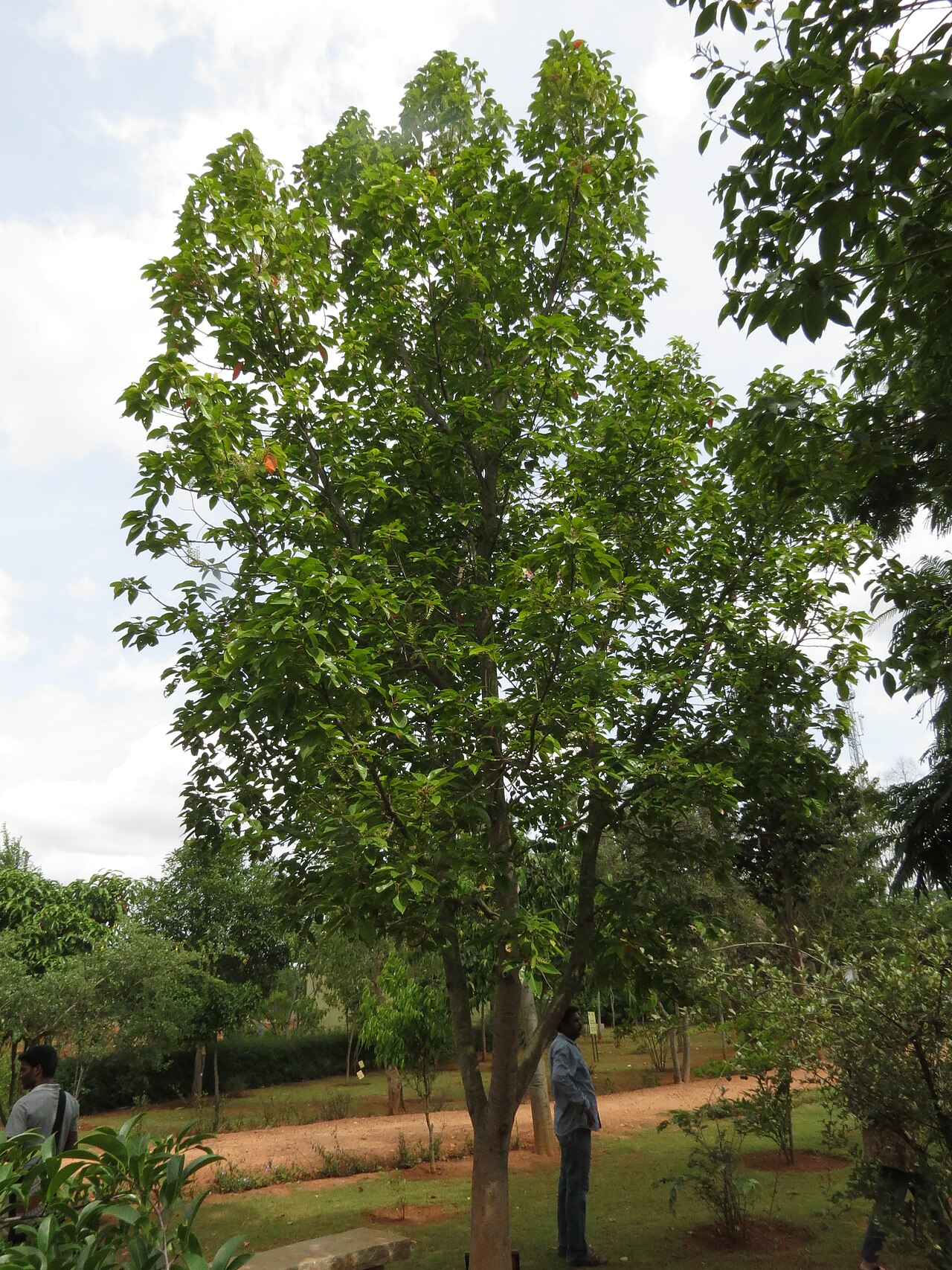
- Indian olive tree: Forestowlet, CC0, Wikimedia Commons
- Jolphai pickle jar: GHARSA
Sources
- Journal of Pharmacognosy and Phytochemistry (2017). Fruiting characteristics of jalpai, the Indian olive (Elaeocarpus floribundus Blume). 6(5).
- Chitra Balasubramaniam, Down To Earth (16 April 2019). Indian olives: The most under-utilised fruit crop.
- Banglapedia, National Encyclopedia of Bangladesh. Olive.
- Royal Botanic Gardens, Kew. Elaeocarpus floribundus Blume, Plants of the World Online.
- eFlora of India. Elaeocarpus floribundus.
- Wikipedia. Elaeocarpus serratus (used as a pointer).
- Specialty Produce. Jalpai.