

Hornbill Festival food is served tribe by tribe: each Naga community runs a kitchen in its own morung at Kisama, so one walk can take you from Ao rosep and Sumi smoked pork with axone to Kuki sticky rice and Rengma yam with mixed leaves. The 27th edition runs from 1 to 10 December 2026 at the Naga Heritage Village, about 12 km from Kohima [1][3]. Here is what to order, morung by morung.
Quick facts
- What: the Hornbill Festival, Nagaland’s state festival of its tribes, named after a bird found in the folklore of most Naga groups [3].
- When: 1–10 December 2026 [1][2], starting on Nagaland’s Statehood Day [1].
- Where: Naga Heritage Village, Kisama, Kohima district, Nagaland [1][3].
- Who cooks: 17 major tribes and their sub-tribes take part [1], and each morung serves its own community’s dishes [6][7].
- Dishes to look for: smoked pork with bamboo shoot or axone, galho, amrusu, rosep, anishi, fish cooked in bamboo, and rice beers such as zutho [4][5][6][8].

What is a morung, and why does Hornbill food happen there?
A morung is a traditional Naga community house; at Kisama, each tribe has one, and it doubles as that tribe’s kitchen, museum and stage. The Morung Express calls the Kisama morungs a living archive, where communities show artefacts and serve traditional food side by side [7].
Every dish is shaped by the tribe that cooks it: galho turns up in several morungs, each seasoned its own way [6]. So eat a little in many morungs rather than a full meal in one.
What Hornbill Festival food should you eat at each morung?
Start with each tribe’s signature dish; reports from the 2024 and 2025 festivals point to clear favourites. Menus change yearly, so treat this as a guide.
- Ao morung: dry pork with anishi (fermented taro leaves shaped into cakes and smoked or sun-dried), rosep (mixed vegetables with dry fish and bamboo shoot), pork with bamboo shoot, amrusu (a rice porridge with chicken and bamboo shoot), and fish cooked in bamboo tubes [8][5].
- Sumi morung: axone, the fermented soybean, is the star, along with smoked pork with axone, a yam curry with mustard leaves and ginger paste [7].
- Rengma morung: a chilli-free dish of yam and mixed leaves, pork cooked with perilla seeds, and a mustard-leaf salad [7].
- Chakhesang morung: local pork, mithun meat, snails and vegetable dishes [7].
- Zeliang morung: chutneys made with jekechang (fermented mustard leaf), snails, spring garlic and red rice [7].
- Yimkhiung morung: maize pickle, beans, cow-leg dishes and lemon tea [7].
- Kuki morung: sticky rice, sausages, galho and coffee, with no alcohol served [7].
- Lotha morung: sticky rice with chutney, pork and chicken with bamboo shoot, and dry beef with black sesame. We wrote about this spread in our Tokhu Emong festival food guide [10].
Expect crowds at the busiest kitchens. Eastern Mirror reported that the Ao kitchen fed over 1,000 people a day in 2025 and ran out of its smoked pork within four days, according to its kitchen committee [9].
Which Naga dishes are famous at Hornbill?
Smoked pork, cooked either with bamboo shoot or with axone, is the dish most visitors queue for. Slurrp notes that the axone version has the stronger aroma [6], and Incredible India lists smoked pork in akhuni (another name for axone) among Nagaland’s signature dishes [4].
A few more names worth knowing:
- Galho: a soupy rice dish with seasonal greens and often smoked pork or pork fat; a vegetarian version uses vegetables and ginger [4][5].
- Hinkejvu: colocasia, cabbage leaves, mustard leaves and beans, boiled with very little seasoning [4][5].
- Samuthu: a slow-cooked pork curry that Incredible India links to the Sumi (Sema) community, served with rice and ginger chutney [4].
- Chutneys: roasted tomato, local chilli, fermented crab and smoked-meat chutneys appear across the morungs [6].
Some stalls also serve insects, snails and wild meat. A UK visitor’s video of silkworm larvae, spiders and porcupine on a Kisama menu went viral in 2025; India Today NE noted these are everyday foods for many Naga communities, and that some wild species served are considered threatened in parts of their range [12]. Farmed pork, fish and vegetables are easy choices.

What is axone, and why does it smell so strong?
Axone (also called akhuni) is soybean that is boiled, left to ferment for a few days, lightly mashed and wrapped in leaves; its name in the Sumi language roughly means “deep smell”. It is made by many tribes but is most closely linked with the Sumi Nagas [13].
Fermentation takes about three to four days in summer and around a week in winter, and gives axone its deep, savoury taste [13].
For Assamese visitors, the smell will feel familiar. We grow up with khorisa, fermented bamboo shoot, and the Ao use bamboo shoot both dried and fermented in dishes like rosep [8]. Different ingredient, same “it smells strong, but wait till you taste it” reaction from friends. Our guide to khorisa, Assam’s bamboo shoot pickle goes deeper.
Can vegetarians eat well at the Hornbill Festival?
Yes, with a little planning: Naga cooking has many vegetable dishes, and vegetarian stalls have appeared at Kisama. Hinkejvu, vegetarian galho, leafy stews and bamboo-shoot dishes are all meat-free in their basic form [4][6].
Do ask first: many vegetable dishes include dry fish or pork fat, as in Ao rosep [8]. Vegetarian stalls, including a vegetarian buffet, have run at Kisama in past editions [11], though line-ups change yearly.
What drinks are served at Hornbill?
Rice beers are part of the festival table, with zutho, a brew of fermented rice, the best known. Incredible India describes zutho as a traditional drink of the Angami Nagas [4], and Slurrp lists zutho and thutse across the festival [6]. The Ao morung alone sold about 1,000 litres of local brew a day in 2025, its kitchen committee told Eastern Mirror [9].
Not drinking? Try lemon tea at the Yimkhiung morung or coffee at the Kuki morung [7]. If you do drink, do so responsibly.
How can you taste Naga food at home?
Cook the simplest dishes first: boiled greens like hinkejvu, plain rice, and a sharp chilli chutney get you close to a Naga everyday meal. Incredible India’s description of hinkejvu, just vegetables and salt, is a good starting point [4].
The Naga chilli in so many morung chutneys is the pepper Assam calls bhoot jolokia (see our bhoot jolokia guide). In our home, a spoon of bhoot jolokia pickle beside rice and boiled greens is the everyday stand-in for a Naga chutney.
Frequently asked questions
What food is famous at the Hornbill Festival?
Smoked pork, cooked with bamboo shoot or with axone (fermented soybean), is the most famous Hornbill Festival dish. Other favourites include galho, a soupy rice dish; amrusu, a rice porridge with chicken and bamboo shoot; Ao rosep; fish cooked in bamboo; fiery chilli chutneys; and rice beers like zutho.
When is the Hornbill Festival 2026?
The 27th Hornbill Festival runs from 1 to 10 December 2026 at the Naga Heritage Village in Kisama, about 12 km from Kohima, Nagaland. It opens on Nagaland’s Statehood Day. The 17 major Naga tribes take part, and each tribe’s morung serves its own traditional food throughout the ten days.
Is there vegetarian food at the Hornbill Festival?
Yes. Naga dishes such as hinkejvu (boiled colocasia, cabbage and mustard leaves), vegetarian galho and leafy stews are meat-free in their basic form, and vegetarian stalls have run at Kisama in past years. Always ask, though, because many vegetable dishes are cooked with dry fish or pork fat.
What is axone in Naga food?
Axone, also called akhuni, is fermented soybean. The beans are boiled, left to ferment for several days, lightly mashed and wrapped in leaves. It has a strong smell and a deep savoury taste, and is most closely linked with the Sumi Nagas. Smoked pork with axone is a Hornbill favourite.
What is a morung at the Hornbill Festival?
A morung is a traditional Naga community house. At Kisama, each tribe builds or keeps its own morung, where it displays artefacts, performs and runs a kitchen serving its own dishes. Moving from morung to morung is the best way to taste the differences between Naga tribal cuisines.
Taste it
Can’t make it to Kisama this December? Bring the heat and the fermented tang home. Our Spice Lovers Box has Original and Mild Bhoot Jholokia with Aam pickle, and our Khorisa (Bamboo Shoot) Pickle is made with bamboo shoot, mustard oil, bhoot jholokia and whole spices. Both go beside hot rice and boiled greens.
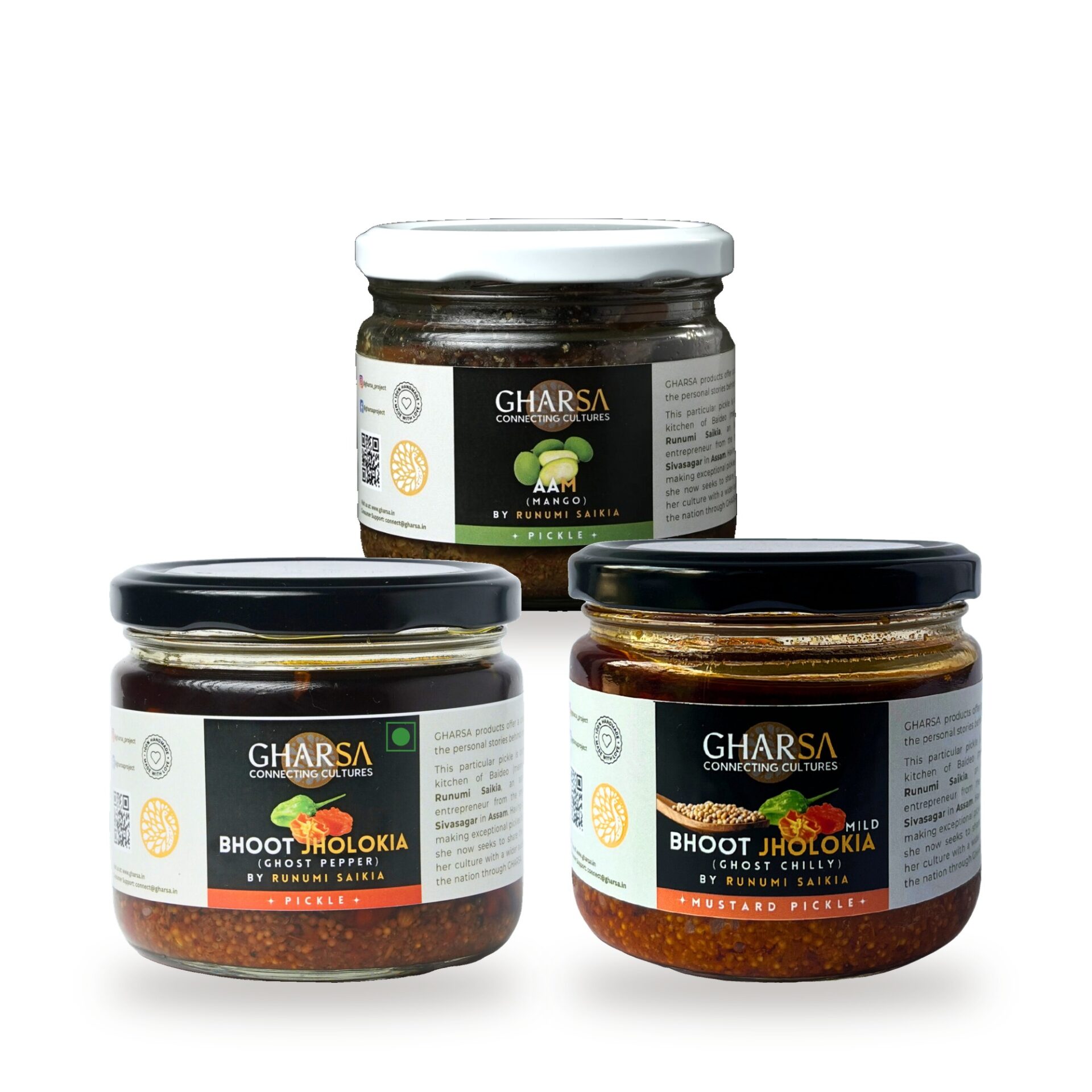
Spice Lovers Box → | All gift boxes | Want us to stock Naga foods like axone or smoked pork? Join the list on WhatsApp
More Northeast festival food this season: Tokhu Emong food of the Lotha Nagas, Wangala festival food in the Garo Hills and Khasi food dishes for Seng Kut Snem.
Image credits
- Featured image: “Naga cuisine”, by Ishani Nath, CC BY-SA 4.0, Wikimedia Commons.
- “Kisama main arena Hornbill Festival 2019”, by Aravind Manickam, CC BY-SA 4.0, Wikimedia Commons.
- “Naga Cuisine”, by JyotiPN, CC BY-SA 4.0, Wikimedia Commons.
- Spice Lovers Box photo: GHARSA.
Sources
- “Nagaland gears up for 27th edition of iconic Hornbill Festival”, DD News, 14 October 2026. ddnews.gov.in
- Nitya Choubey, “Everything you need to know about Hornbill Festival 2026 at Kisama in Nagaland”, Time Out India, 16 September 2026. timeout.com
- “Hornbill Festival”, Wikipedia (used as a pointer). en.wikipedia.org
- “Food guide: traditional Naga dishes”, Incredible India, Ministry of Tourism, Government of India. incredibleindia.gov.in
- “Six Traditional Naga Dishes You Must Try At The Hornbill Festival”, Outlook Traveller, 5 December 2022 (updated 18 January 2024). outlookindia.com
- Akshara, “Hornbill Festival Nagaland: A Culinary Map Of Tribal Traditions”, Slurrp, December 2025. slurrp.com
- Tokavi K Zhimo, “Cultural Hearths: Step inside the indigenous Naga Morungs”, The Morung Express, 2 December 2025. morungexpress.com
- “Ao delicacies a hit in Kisama”, The Morung Express (DIPR report), 4 December 2024. morungexpress.com
- Livine Khrozhoh, “Hornbill Festival 2025: Brew, stew break records at Ao Morung”, Eastern Mirror, 2025. easternmirrornagaland.com
- “Lotha Morung draws crowds with traditional food and cultural displays”, The Morung Express, 7 December 2025. morungexpress.com
- “Looking for vegetarian food in Kisama? Find Veg Trial and Swastik Khana”, The Morung Express, 8 December 2019. morungexpress.com
- “Spiders, porcupine, and civet cat: Hornbill Festival menu shocks UK tourist in Nagaland”, India Today NE, 7 December 2025. indiatodayne.in
- “Axone”, Wikipedia (used as a pointer). en.wikipedia.org



[…] said every vegetable and ingredient came from Wokha [7]. Going to Kisama this December? Our Hornbill Festival food guide covers what each Naga morung […]