

The best things to buy in Assam, if you love food, are Assam tea, the state’s GI-registered rices (joha, boka and chokuwa), Karbi Anglong ginger, kaji nemu lemons, bhoot jolokia and a few jars of local pickle. For crafts, the handwoven gamosa, the bamboo jaapi hat and muga silk are the classic picks [5][6]. Here is what each one is, where people in Guwahati actually shop for them, and how to get it all home without a leaking suitcase.
Quick facts
- Tea: Assam grows over half of India’s tea, and the industry marked 200 years in 2023, counted from 1823, when Robert Bruce found tea growing wild in the region [7].
- GI-registered foods of Assam: Assam tea, joha rice, boka chaul, chokuwa rice, Karbi Anglong ginger, Tezpur litchi and kaji nemu, among others [5][6].
- Where locals shop: Beltola Market in south Guwahati, held every Thursday and Sunday, with sellers from the Khasi, Jaintia, Karbi, Bodo and Manipuri communities [3].
- Tea trade hub: the Guwahati Tea Auction Centre, opened on 25 September 1970 [8][9].
- Flying home: pickles and other wet foods count as liquids or gels, so containers over 100 ml go in checked baggage [1][2].
What are the best food things to buy in Assam?
Start with the things that are hard to find outside the Northeast and travel well: dry leaf tea, raw rice, dried spices and sealed pickles.
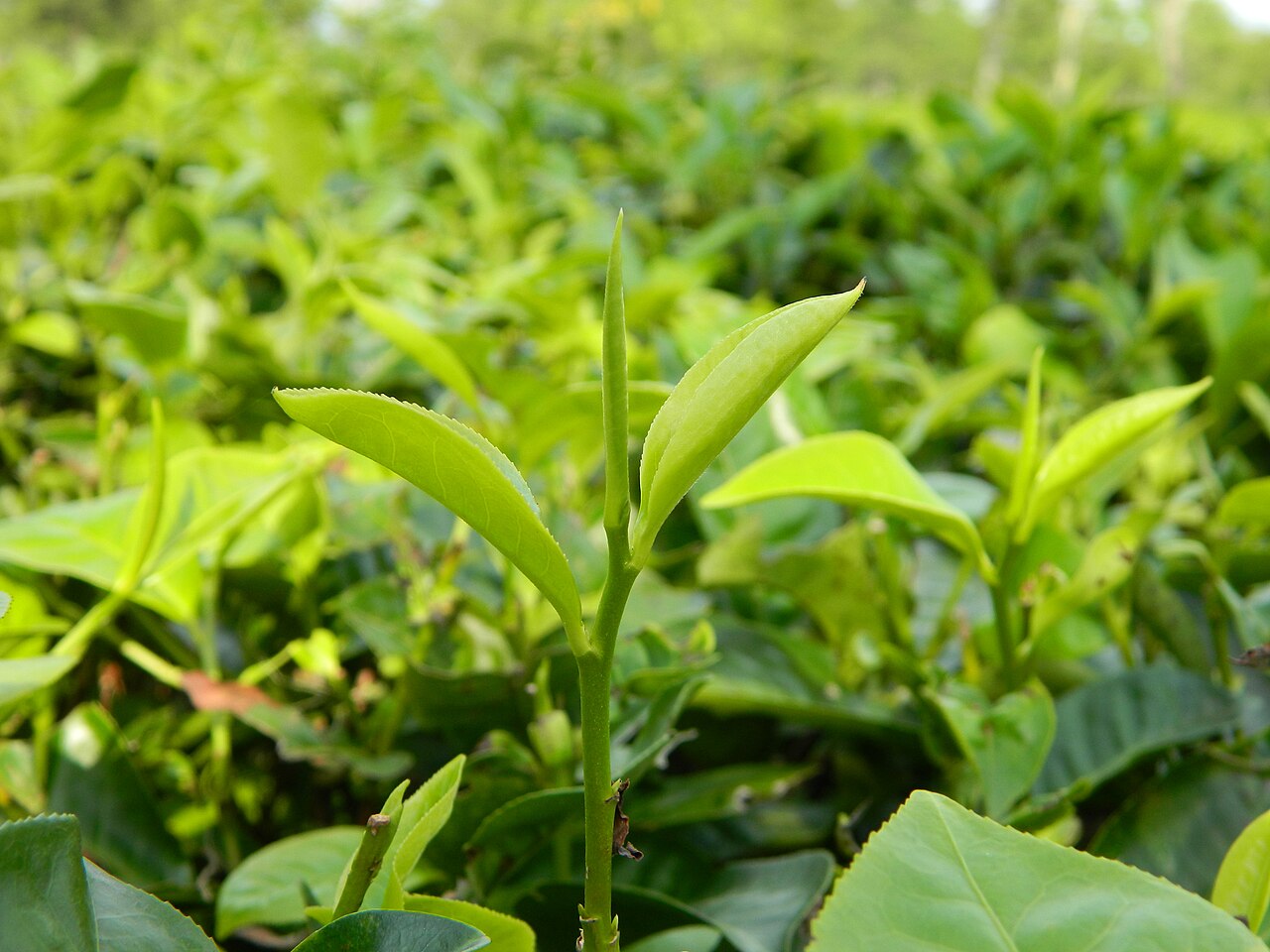
Assam tea: CTC for a strong cup, orthodox for a gift
Assam produces more than 50 per cent of India’s tea, according to figures shared at the Tea Board’s bicentenary logo launch in 2023 [7]. “Assam Tea” was the first product from the state to receive GI protection [6].
CTC (crush, tear, curl) tea makes the strong, malty cup most of India drinks with milk [10]. The other style, orthodox, is registered separately as “Assam Orthodox” [5]. It comes as loose leaf rather than granules, and for a gift we’d pick a packet from a named estate. Outlook Traveller suggests buying fresh leaf at estates and garden shops around Jorhat, Dibrugarh and Tinsukia [10].
Assam’s tea trade has its own hub, the Guwahati Tea Auction Centre, opened in 1970 [8][9]. In 2017 it sold about 186 million kg, the highest of any auction centre in India [8]. Sources differ on its world rank: the Assam Tribune calls it the second-largest CTC auction after Kenya’s [8], while Wikipedia describes it as the largest CTC auction by volume [9].
Rice you won’t find elsewhere: joha, boka and chokuwa
Assam has three GI-registered rices, and each does a different job [5][6]:
- Joha saul (joha rice): small-grained and fragrant, used for payokh and pulao. We wrote a full guide to joha rice and how it differs from basmati.
- Boka saul (boka chaul, sometimes called “mud rice”): grown mainly in Nalbari, Barpeta and Darrang, it softens after soaking in water and needs no cooking [6].
- Chokuwa saul (chokuwa rice): a soft rice traditionally eaten in the Ahom royal court and used in Bihu dishes [6].
Beltola Market also sells black rice and bora (glutinous) rice alongside joha [3].
Ginger, lemon and chilli: the Assamese spice bag
Karbi Anglong ginger, from the hill district of the same name, is GI-registered and known for strong aroma and low fibre [6]. Kaji nemu, the juicy lemon that is Assam’s state fruit, is also GI-registered [6]. And bhoot jolokia, the ghost pepper, turns up in local markets such as Beltola [3]. Our bhoot jolokia guide explains how hot it is and how Assamese homes use it.
Pickles: the souvenir every Assamese family packs
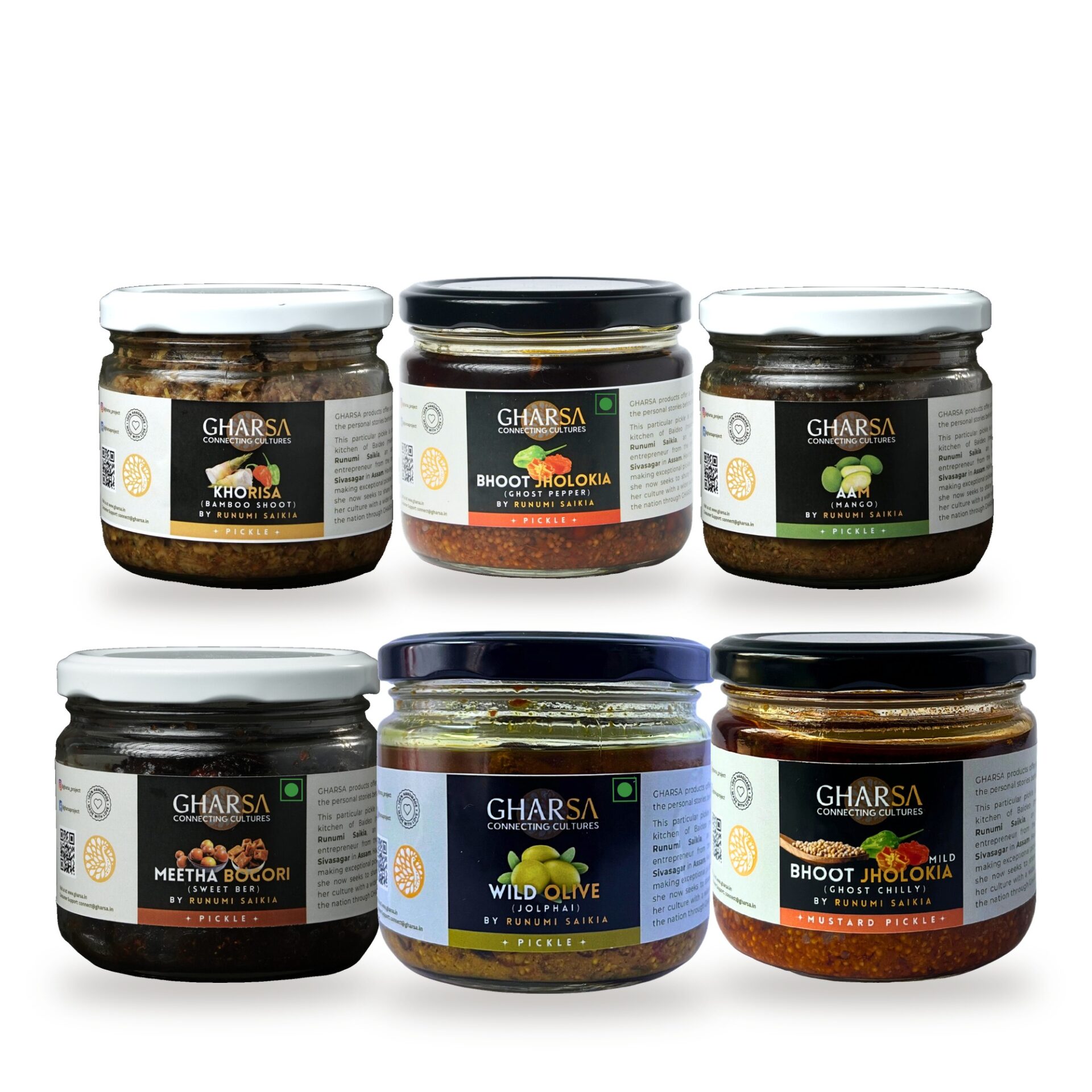
In our own families, nobody leaves Assam without a jar or two of achar (pickle) in the bag. The classics are khorisa (fermented bamboo shoot), bogori (Indian jujube), jolphai (Indian olive), ou tenga (elephant apple) and, for the brave, bhoot jolokia. Our guide to Assamese pickles covers what each one tastes like and what it goes with.
Where do locals shop for food in Guwahati?
For local produce, Beltola Market is the place. It sets up every Thursday and Sunday in Beltola, next to the Dispur capital complex, and an account by EcoNE traces it back to the Ahom period [3].
Its traditional sellers come from the Khasi and Jaintia hills of Meghalaya, the Karbi and Bodo villages around Sonapur, and Manipuri families from Hojai, and many of the tribal vendors are women [3]. Alongside everyday vegetables you’ll find things rarely sold elsewhere: dried fish, silkworm pupae, bamboo shoot, khar (an alkali used in cooking), thekera (a souring agent), seuli (night jasmine) flowers, guti aloo (small potatoes), kaji nemu, Karbi Anglong ginger and bhoot jolokia [3].
Fancy Bazar is the old trading heart of the city. In the 1940s it had only about 100 shops, most of them grocers, and street sellers offered mustard oil, jaggery, muri (puffed rice) and chira (flattened rice) [4].
Tip: go to Beltola early, carry small change and cloth bags, and ask sellers what is in season.
What non-food souvenirs are worth buying in Assam?
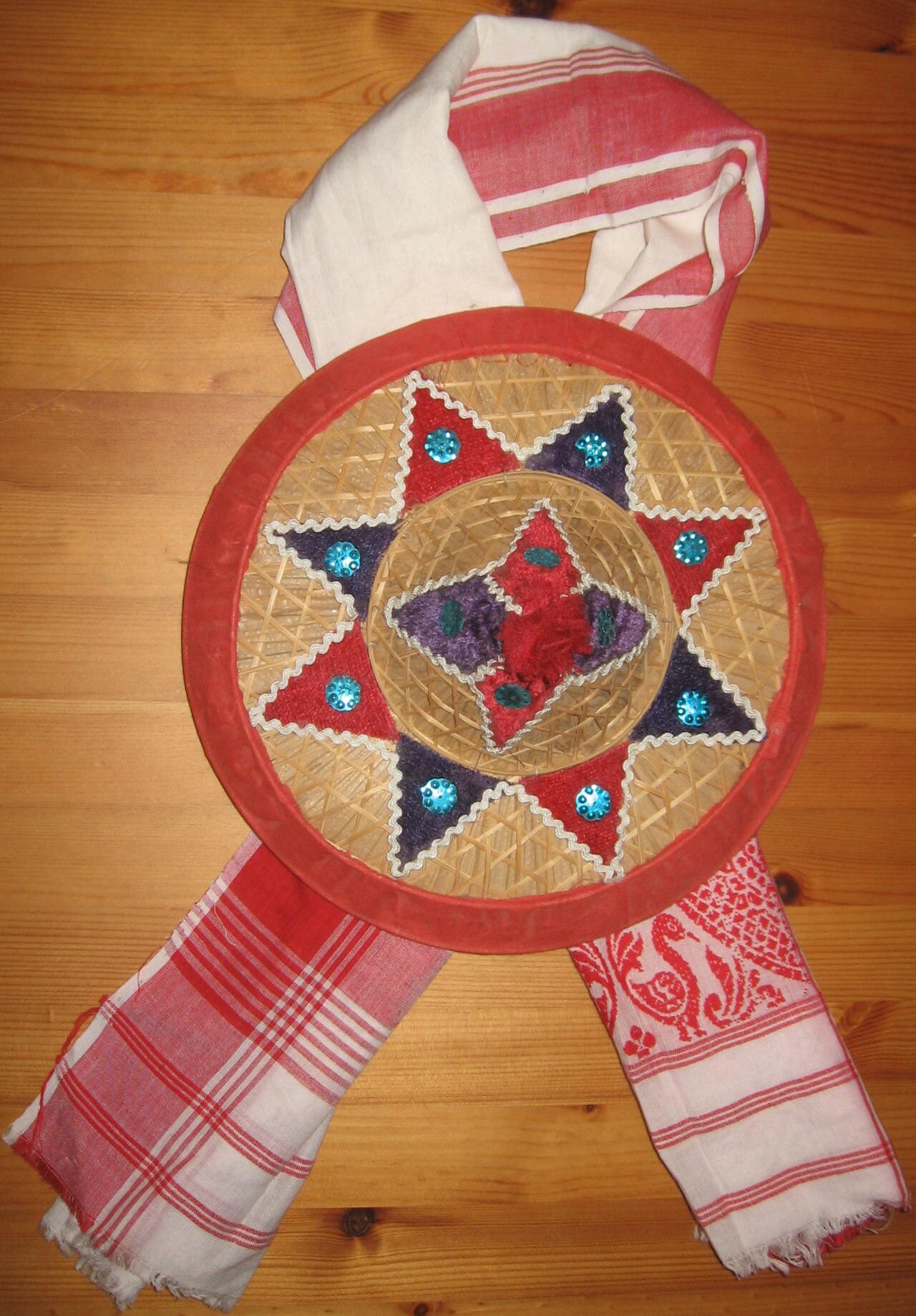
If you want something that isn’t edible, four crafts carry GI recognition [5][6][11]:
- Gamosa: the white handwoven cotton cloth with red borders and woven motifs, used at Bihu and at ceremonies [6]. It received its GI certificate on 13 December 2022, after an application filed in 2017 by the Institute of Handicraft Development, Golaghat [11].
- Jaapi: the conical bamboo and palm-leaf hat, first made to shield farmers and fishermen from sun and rain; GI-registered in 2024 [5][10].
- Muga silk: the naturally golden silk from the Antheraea assamensis silkworm [6].
- Sarthebari bell metal: GI-registered in 2024 [5].
How do you carry Assam food home on a flight?
Pack anything wet in checked baggage. Air India asks passengers not to carry liquids, aerosols or gels over 100 ml in cabin bags [1], and travel guides note that airport security treats pickle as a gel, with the limit applying per container, not to how full it is [2].
- Cabin bag: dry tea, rice, dried chillies and sealed snacks. Pickle only in containers of 100 ml or less [1][2].
- Checked bag: full jars of pickle, honey or mustard oil. Tape the lid, put each jar in two zip-lock bags and wrap it in clothes in the middle of the suitcase [2].
- Leave behind: fresh fish, cooked dishes and pitha, which are best eaten fresh.
Airline and airport rules change, so check your airline’s page before you fly.
Taste it
Our Best of Assam Gift Box packs all six GHARSA pickles, including Khorisa, Meetha Bogori, Jolphai and Original Bhoot Jholokia, in one box, so you can bring Assam home without the airport queue. We don’t sell tea or joha rice yet; tell us if you’d like us to.
Best of Assam Gift Box → | All gift boxes | Want us to stock Assam tea or joha rice? Join the list on WhatsApp
Frequently asked questions
What is the most famous thing to buy in Assam?
Assam tea is the most famous buy. The state grows over half of India’s tea, and Assam Tea was the state’s first GI-registered product. Strong CTC tea suits everyday milky chai, while whole-leaf orthodox tea from a single estate makes a better gift. Muga silk and the gamosa are the best-known crafts.
What food can I take back from Assam?
Dry, sealed foods travel best: Assam tea, joha, boka and chokuwa rice, Karbi Anglong ginger, dried bhoot jolokia and jars of local pickle such as khorisa, bogori or jolphai. Fresh fish, cooked dishes and pitha spoil quickly, so enjoy those during your trip rather than packing them.
Can I carry pickles on a flight from Guwahati?
Yes, but put jars over 100 ml in checked baggage. Airlines treat pickle as a liquid or gel, and the 100 ml cabin limit applies to each container regardless of how full it is. Tape the lid, double-bag the jar in zip-locks and pack it in the middle of the suitcase, wrapped in clothes.
Where can I buy local food in Guwahati?
Beltola Market in south Guwahati, held every Thursday and Sunday, is the best place for local produce such as joha and black rice, bamboo shoot, khar, kaji nemu and bhoot jolokia. Fancy Bazar, the city’s old trading district, began as a cluster of grocery shops and is worth a walk for dry goods.
Which Assam tea should I buy as a gift?
For a gift, choose whole-leaf orthodox tea from a named estate, ideally bought at a garden shop in Jorhat, Dibrugarh or Tinsukia. Check the packing date before you buy. For someone who drinks strong milky chai every day, a good-quality CTC tea from Assam is the more practical choice.
More from Assam’s kitchens: joha rice, Assam’s aromatic rice, and food gifts from Assam.
Image credits
- Featured image: “A vendor arranging his vegetables at the sunday Beltola Market of Guwahati city”, by Ishanjyotibora, CC BY 4.0, Wikimedia Commons.
- “Tea, two leaves and a bud”, by Nborkakoty, CC BY-SA 3.0, Wikimedia Commons.
- “Jaapi with Gamosa”, by Deepraj, CC BY 2.5, Wikimedia Commons.
- Best of Assam Gift Box photo: GHARSA.
Sources
- “Cabin baggage”, Air India. airindia.com
- “Can I carry pickle, curd and Ayurvedic medicines on Indian flights?”, HappyFares, June 2026 (updated November 2026). happyfares.in
- “The living tradition of Beltola bi-weekly market”, EcoNE. econe.in
- Ajit Patowary, “Fancy Bazar had only around 100 shops in 1940s”, The Assam Tribune, 2010. assamtribune.com
- “GI tag given to Assam’s traditional items, products”, The Sentinel Assam, 1 April 2024. sentinelassam.com
- “Major GI-tagged products from Assam”, GKToday (used as a pointer). gktoday.in
- “Logo on 200 years of Assam Tea unveiled”, EastMojo, 22 May 2023. eastmojo.com
- “GTAC country’s No 1, world’s second largest”, The Assam Tribune (2017 figures). assamtribune.com
- “Guwahati Tea Auction Centre”, Wikipedia (used as a pointer). wikipedia.org
- Nidhi Kadere, “Unique souvenirs to bring home from Northeast India”, Outlook Traveller, 10 January 2024. outlooktraveller.com
- “Assam celebrates as gamocha gets GI tag”, EastMojo, 14 December 2022. eastmojo.com


[…] post on the cultural tapestry of India’s Northeast. Visiting Guwahati yourself? Our list of things to buy in Assam covers tea, local rice and how to pack pickles for the flight […]