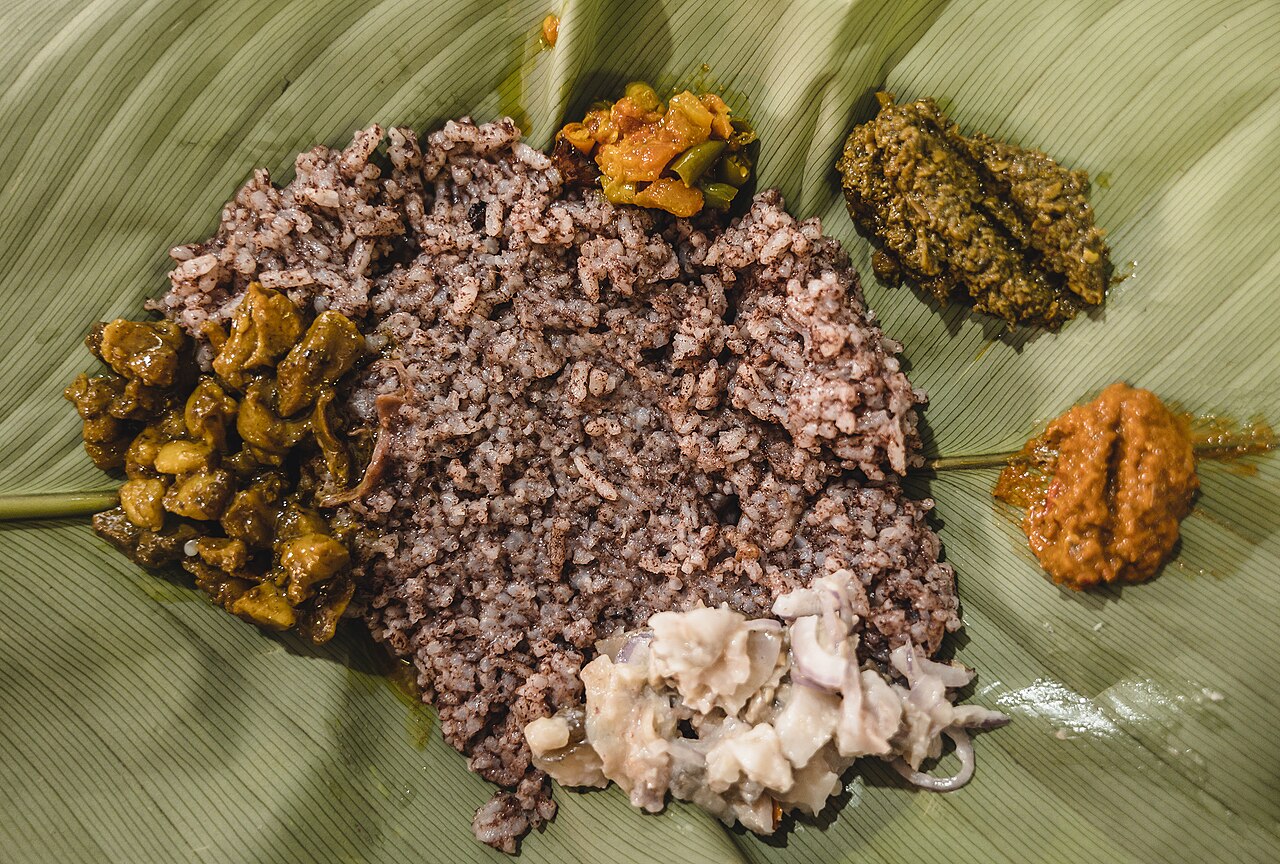
The Khasi food dishes to know are jadoh (rice cooked with pork), dohneiiong (pork in a black sesame gravy), dohkhlieh (pork salad) and tungrymbai (fermented soybean with black sesame), with rice cakes and red tea on the side. They are the everyday and festive food of the Khasi people of Meghalaya. This guide explains each one, and why late November, when Shillong marks Seng Kut Snem on 23 November 2026, is a good time to learn about them [2][7][8].
Quick facts
- Who: the Khasi, the largest community in Meghalaya [2].
- Signature dishes: jadoh, dohneiiong, dohkhlieh, tungrymbai, plus jingbam dihsha (rice snacks) with red tea [7][8].
- Key flavours: pork, red rice, black sesame, fermented soybean, ginger and turmeric, with chilli served on the side [7][9][10].
- Seng Kut Snem 2026: Monday, 23 November, a regional holiday in Meghalaya, the day before the Khasi New Year [2].
- Edition: 2025 was the 126th Seng Kut Snem [3][4], so 2026 should be the 127th.
What is Seng Kut Snem?
Seng Kut Snem is the year-end festival of the Seng Khasi, a movement started in 1899 to protect the indigenous Khasi faith, culture and language. The name breaks down simply: kut means to close and snem means year, so it marks the closing of the Seng Khasi year [5].
The Ministry of Tourism’s festival page says sixteen young men founded the group, first called the Khasi Young Men’s Association, to safeguard their traditional way of life, known as Niam Trai Niam Tre [1]. Sources disagree on the exact founding date: one Shillong report gives 23 August 1899 [6], while a Bangladesh newspaper gives 23 November 1899 [5]. The festival itself is held on 23 November every year [2][4].
The movement now has more than 300 branches across Meghalaya [4]. Khasi communities in Sylhet, Bangladesh, also celebrate; in 2025 they gathered at Magurchhara on 22 November [5].
How is Seng Kut Snem celebrated in Shillong?
The day centres on a cultural procession through Shillong that ends at Weiking Ground in Jaiaw, followed by prayers, dances and games. The procession, called Iaid Pyni Riti, shows different sides of Khasi life [1]. In 2025 it started at Madan Iewrynghep and wound through the city’s streets [3].
At the ground, Seng Khasi priests offer prayers, and the afternoon fills with folk music, traditional dances, speeches, games and displays of handmade goods [1][2][3]. Elders also use the day to pass on oral teachings about Khasi beliefs and customs [1].
One honest note: none of the festival reports we read describe a fixed Seng Kut Snem menu. What people eat is the food of Khasi homes, so that is where the rest of this guide goes.

What are the most famous Khasi food dishes?
Jadoh, dohneiiong, dohkhlieh and tungrymbai are the four names you will hear first, usually eaten together on one plate. Meghalaya Tourism describes jadoh served with dohkhlieh and tungrymbai as a classic combination [7].
Jadoh: rice cooked with pork
Jadoh is rice simmered with pork, onion, ginger, garlic and turmeric [9]. Many cooks use the red rice grown on Meghalaya’s slopes, which gives the dish its earthy colour [10]. Some add pork liver or blood for richness, and it was traditionally slow-cooked in clay pots over embers or even inside bamboo [9]. Outlook Traveller notes that jadoh is a favourite at festivals and family gatherings [9].
Dohneiiong: pork in black sesame
Incredible India calls dohneiiong a Khasi delicacy loved across Shillong: pork cooked in a dark gravy of ground black sesame seeds with chillies [8]. The sesame makes the sauce nutty and almost black. The same idea appears with fish in ktung bain nei-iong, dried fish cooked with black sesame [7].
Dohkhlieh: the pork salad
Dohkhlieh is a salad of pork mixed with onion, green chilli and salt [7][8]. Incredible India points out it has no fixed recipe, so every home does it a little differently [8]. Meghalaya Tourism lists it under Jaintia cooking too, a reminder that Khasi and Jaintia (Pnar) kitchens share a lot [7].
Tungrymbai: fermented soybean
Tungrymbai is fermented soybean cooked with black sesame, and it gives a meal its deep, savoury flavour [7][10]. It is popular among both the Khasi and the Garo, and researchers have recently studied the traditional product in the lab [12]. It is also one of the vegetarian choices at a Khasi table [10].
What do Khasi people eat with red tea?
Rice cakes and snacks known together as jingbam dihsha, made from ground rice with sugar or jaggery and served with red tea. Meghalaya Tourism names several: pumaloi (steamed rice cake), pukhlein (fried rice cake), pusla (rice cake steamed in a leaf), pudoh (steamed with pork strips) and jashulia (sticky rice) [7].
Pusaw is another, a cake of red rice flour baked in a pot with charcoal on the lid. The Meghalaya Basin Development Authority says the best known comes from Mawranglang village in South West Khasi Hills, and that families bake 80 to 100 cakes a day in festive seasons against 20 to 30 in summer [11].
This part feels like home to us. In Assamese houses a guest gets lal sah, milkless red tea, with pitha, and the Khasi pairing of rice cake and red tea follows the same instinct.
Is Khasi food spicy?
Not in the masala sense: Khasi cooking leans on pork, sesame, ginger and fermentation, and the heat sits on the side. InHERIT, an Ashoka University heritage project, describes Khasi food as less elaborately spiced than its neighbours [10], and Meghalaya Tourism says jadoh’s flavour comes from fermented soybean and sesame rather than heavy spicing [7].
The chilli arrives through chutneys. Tungtap, a chutney of fermented dried fish, is eaten with boiled potatoes called phan [7]. You will often see raw green chillies on the plate as well, as in the jadoh photo above.
How are Khasi meats smoked and cooked?
Meat is often smoked above the kitchen fire, sometimes for months, to add flavour and keep it longer. InHERIT describes this as an old preservation method that gives Khasi meats their flavour [10]. Smoked meats also feature at Nongkrem, another Khasi harvest festival [10].
Bamboo is the other tool. Ja tyndong is rice, fish, meat and vegetables sealed in a fresh bamboo tube with banana leaves and roasted until the outside chars [7]. We cook rice in bamboo in Assam too, so this one always makes us smile.
Meghalaya’s other big November feast belongs to the Garo Hills. Read our guide to Wangala festival food and the 100 Drums harvest to compare the two kitchens.
Frequently asked questions
What is Seng Kut Snem?
Seng Kut Snem is the year-end festival of the Seng Khasi, the movement founded in 1899 to keep the indigenous Khasi faith and culture alive. In Shillong it is marked with a cultural procession to Weiking Ground in Jaiaw, prayers by Seng Khasi priests, folk dances and traditional games.
When is Seng Kut Snem 2026?
Seng Kut Snem falls on Monday, 23 November 2026, according to Office Holidays, which lists it as a regional holiday in Meghalaya. It is held every year on 23 November, the day before the Khasi New Year, which Office Holidays dates to 24 November.
What are the most famous Khasi food dishes?
The best-known Khasi food dishes are jadoh (rice cooked with pork), dohneiiong (pork in a black sesame gravy), dohkhlieh (a pork salad with onion and chilli) and tungrymbai (fermented soybean cooked with black sesame). Rice snacks such as pumaloi and pusaw are eaten with red tea.
What is jadoh made of?
Jadoh is rice cooked with pork, usually with turmeric, ginger, garlic and onion. Many cooks use the local red rice, which gives the dish its colour. Some add pork liver or blood for richness, and it is often served with dohkhlieh or fermented soybean on the side.
Is Khasi food spicy?
Khasi food is usually less heavily spiced than many Indian cuisines. Dishes like jadoh get their flavour from pork, turmeric, black sesame and fermented soybean rather than masala. The heat comes on the side: green chillies, chilli in dohneiiong, and sharp chutneys such as tungtap made with dried fish.
Taste it
A Khasi plate keeps its fire on the side, and so does ours. A small spoon of our Original Bhoot Jholokia pickle beside hot rice and pork is how many Northeast homes eat it. Want something gentler? Try the Spice Lovers Box with the Mild version and Aam pickle too.
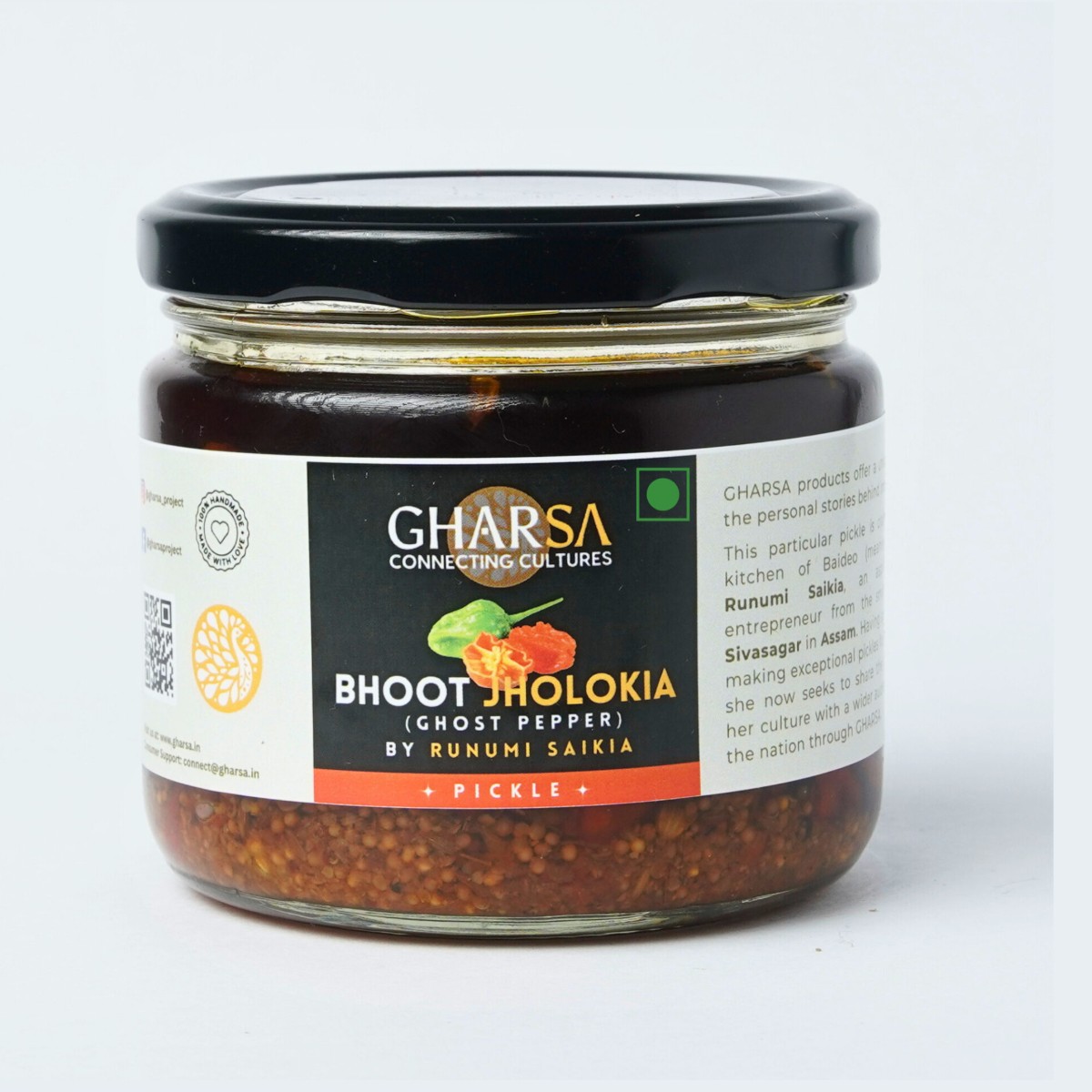
Original Bhoot Jholokia → | All gift boxes | Want us to stock Khasi foods like black sesame or tungrymbai? Join the list on WhatsApp
Image credits
- Featured image: Jadoh in a Leaf, by Wann Majaw, CC0, Wikimedia Commons.
- Jadoh, by Wann Majaw, CC0, Wikimedia Commons.
- Khasi Lady in a Kitchen, by Wann Majaw, CC0, Wikimedia Commons.
- Original Bhoot Jholokia jar: GHARSA.
Sources
- “Seng Kut Snem”, Utsav, Ministry of Tourism, Government of India. utsav.gov.in
- “Seng Kut Snem in Meghalaya in 2026”, Office Holidays. officeholidays.com
- “Meghalaya: Seng Kut Snem celebrated with grand procession and traditional dances”, The Sentinel (Assam), 24 November 2025. sentinelassam.com
- “Echoes of ancestry resound at Lum Sohpetbneng as Seng Khasi Kmie marks 125 years of faith and heritage”, Borderlens, 10 November 2025. borderlens.com
- “Guardians of the ancestral year”, Janomot (English), 23 November 2025. english.janomot.com
- “122nd Seng Kut Snem celebrated in Shillong city”, EastMojo, 23 November 2021. eastmojo.com
- “Flavours of Heritage”, Meghalaya Tourism, Government of Meghalaya. meghalayatourism.in
- “Food and cuisine: Shillong”, Incredible India, Ministry of Tourism. incredibleindia.gov.in
- “The Khasi people of Meghalaya love their jadoh and you might too”, Outlook Traveller (OT Eats), 24 May 2026. oteats.outlooktraveller.com
- Sulagna Maitra, “A Smoky Symphony: Unveiling the Soulful Flavors of Khasi Cuisine”, InHERIT, Ashoka University, 30 May 2024. inherit.ashoka.edu.in
- “The traditional cake of the Khasis – Pusaw”, Meghalaya Basin Development Authority. mbda.gov.in
- Hati S. et al., “Bio-functional properties and anti-inflammatory activity on the RAW macrophage cell line of Tungrymbai, a traditional fermented soy food of Meghalaya”, Indian Journal of Experimental Biology 62(9), 2024. or.niscpr.res.in



[…] Wangala sits in a busy season of Northeast harvest and family feasts. In Manipur, the same month brings Ningol Chakouba, a festival feast for married daughters. Closer to home in Meghalaya, the Khasi of Shillong mark Seng Kut Snem in late November; read our guide to Khasi food dishes like jadoh and dohneiiong. […]